


“I help organisations work through difficult or unusual data protection issues and give clear, practical advice on what they need to do next.”
Gbenga Onojobi
Data Protection Consultant
Gbenga's Posts
Could the UK Really Scrap GDPR and Keep EU Adequacy?
Could the UK Really Scrap GDPR and Keep EU Adequacy?
Reform UK wants a New Zealand-style privacy regime. Would that actually reduce the compliance burden for UK businesses?
Written by Mark Farrell and Gbenga Onojobi.
Reform UK has proposed replacing the UK GDPR with what it describes as a “light-touch” privacy law modelled on New Zealand. The pledge forms part of its Contract with Small Business, published on 26 August 2026, and is presented as a way of reducing the regulatory burden for smaller firms and technology businesses.
At this stage, however, there is no detailed Bill setting out what a replacement regime would contain. The proposal therefore raises more questions than answers. In particular, would a New Zealand-style model significantly reduce compliance costs for UK businesses, what would the wider implications be for data protection in the UK, and could the UK make such a change without putting its EU adequacy status at risk?
What Is Actually Being Proposed?
The proposal is not to remove privacy law altogether. New Zealand has a comprehensive privacy regime under the Privacy Act 2020, but it is structured differently from the UK GDPR.
Rather than using the GDPR’s detailed framework of lawful bases and accountability requirements, New Zealand’s legislation is built around Information Privacy Principles governing how personal information is collected, stored, used, disclosed and transferred. Individuals have rights of access and correction, organisations must report serious privacy breaches, and the regime includes regulatory and enforcement powers.
New Zealand has also continued to develop its privacy framework. Since 1 May 2026, Information Privacy Principle 3A has introduced additional transparency requirements where organisations collect personal information indirectly.
Therefore, “light-touch” should not be read as meaning little or no regulation. New Zealand takes a less prescriptive approach in some areas, but organisations still have legal duties and individuals still have enforceable privacy rights.
Could a New Zealand-Style Model Work in the UK?
In principle, yes. GDPR is not the only possible model for regulating personal information. The fact that the UK recognises New Zealand as offering adequate protection shows that the standard is recognised as sufficient overall.
One reason New Zealand has featured so prominently in the proposal is that it already benefits from an EU adequacy decision. In January 2024, the European Commission concluded that New Zealand continued to provide an adequate level of protection for personal data transferred from the EU. However, New Zealand’s adequacy status does not mean that the UK could simply adopt parts of its legislation and automatically retain its own adequacy decision.
The Commission assesses a country’s framework as a whole. This includes individual rights, regulatory oversight and enforcement, international transfers, and the circumstances in which public authorities may access personal data.
The UK’s own adequacy decision was renewed in December 2025, after the Commission considered the reforms introduced by the Data (Use and Access) Act 2025. The current decision runs until December 2031, subject to continued monitoring.
For UK businesses, adequacy has a clear practical benefit. It allows personal data to flow from the EEA to the UK without organisations having to put additional transfer safeguards in place. If adequacy were lost, many businesses would instead need to rely on mechanisms such as Standard Contractual Clauses.
A reform intended to reduce domestic compliance costs could therefore create a different set of costs if UK-EU data transfers became more complicated.
The UK Has Already Been Reforming GDPR
The Data (Use and Access) Act 2025 has already changed significant parts of the UK data protection framework without replacing the UK GDPR. Its reforms include changes to rules around automated decision-making, recognised legitimate interests, international transfers, subject access, and storage and access technologies such as cookies.
This raises a fair policy question: if the aim is to reduce unnecessary compliance burdens, does that require wholesale replacement of the UK GDPR, or can the UK continue making targeted changes within the existing framework?
In our view, the evidence on burden is mixed. The UK Business Data Survey 2026 found that 90% of businesses handling digitised personal data said data protection law had not prevented them from carrying out any of the activities surveyed. Only 1% specifically reported being prevented from introducing a new or significantly improved product, process or business model. At the same time, 19% said their compliance burden had increased, while 76% said it had remained broadly the same.
Reframing Data Protection as Red Tape Overlooks What the Law Is Actually For
The language used to introduce Reform UK’s pledge, including businesses being “suffocated” and “strangled” by regulation, is entirely cost-focused. It says nothing about what the UK GDPR secures for the people it protects. Some of what could be lost is not simply paperwork.
Of the potential losses should the UK mimic New Zealand’s approach, the right to erasure is perhaps the most significant, as New Zealand’s Privacy Act has no direct equivalent. This is an important privacy remedy that allows individuals to compel the removal of inaccurate or unwanted personal data in many circumstances. It is not merely a compliance formality.
The same is true of mandatory DPIAs, which require organisations to assess risk before deploying high-risk processing. Framing these protections purely as a burden for organisations ignores the imbalance of power they exist to address.
Individuals generally cannot negotiate terms with a bank, employer or advertising technology platform. Rights of access, rectification and erasure are among the main tools available to them. A reform proposal that focuses only on costs to businesses, without considering what protections individuals may lose, fails to engage with an important underlying purpose of data protection law.
A Lighter Penalty Regime May Cost More Than It Saves
The gap between the fine structures of the UK GDPR and New Zealand’s regime is significant, ranging from a ceiling of £17.5 million or 4% of global turnover under the UK GDPR to fines of approximately £4,500 in New Zealand, alongside compensation awards capped at NZ$350,000.
Such a significant reduction in monetary sanctions could weaken the deterrent effect provided by larger fines. This may lead some organisations to take a more relaxed approach to data protection, including slower breach responses, reduced investment in security and less appetite for proactive risk assessment.
Organisations may make compliance savings, but there is a risk that the cost would be passed to individuals through lower standards of protection.
The argument that the EU’s adequacy decision for New Zealand means the UK would retain adequacy if it proceeded with Reform UK’s proposal is not without merit. However, adequacy is monitored continually and should not be treated as a foregone conclusion.
If UK law diverged sufficiently to place adequacy at risk, businesses could lose frictionless data flows with the EU and would need to invest in appropriate safeguards and transfer risk assessments for affected transfers. That cost could fall hardest on the small businesses the policy is intended to help.
Weakening the Regime Now Is a Mistimed Bet Against Emerging Technology
Notably absent from the debate so far is consideration of artificial intelligence and its associated risks, which a robust data protection framework can help to address. This is significant because the safeguards a lighter regime might lack are precisely those increasingly needed for AI-era processing.
Mandatory DPIAs require organisations to scrutinise automated decision-making, profiling and biometric systems before they go live. Removing that requirement would reduce oversight at the same time these systems are scaling rapidly.
The right to erasure also raises new and unresolved questions in an AI context, including whether a person can have their data removed not only from a database but also from a trained model. A regime without a standalone right to erasure may be less equipped to address that question.
A significantly reduced penalty ceiling may also be poorly matched to AI-driven harm, which can affect large numbers of people simultaneously in ways that a relatively small fixed fine cannot reflect.
The more defensible path, and one the UK has already demonstrated through the Data (Use and Access) Act 2025’s changes to automated decision-making provisions, is targeted adaptation within the existing framework rather than a wholesale switch to a lighter regime developed before AI-scale processing existed.
Would Scrapping GDPR Remove Cookie Banners?
Not by itself.
The specific UK rules governing cookies and similar technologies sit mainly within the Privacy and Electronic Communications Regulations 2003, commonly known as PECR. The UK GDPR applies alongside PECR and provides the standard for valid consent where consent is required.
The Data (Use and Access) Act 2025 has already introduced additional exceptions for certain low-risk storage and access technologies. However, removing the UK GDPR alone would not automatically remove cookie consent requirements unless PECR were also changed.
Would UK Businesses Really Leave GDPR Behind?
Not necessarily.
A UK business offering goods or services to individuals in the EU, or monitoring their behaviour there, may still fall directly within the territorial scope of the EU GDPR.
For some internationally active businesses, replacing the UK GDPR could therefore mean complying with a new domestic privacy regime while continuing to meet EU GDPR requirements separately. This is an important part of the wider debate. Simplifying domestic rules does not necessarily mean simplifying compliance for every UK business.
There is also the question of potential cost savings. The idea that a simpler regime would automatically mean lower costs overlooks the fact that the EU GDPR would continue to apply to many UK businesses.
Those businesses may gain little practical or financial relief from a lighter UK regime. Instead, they could be required to meet two distinct standards, potentially at a greater cost than satisfying one.
Where This Leaves Businesses
For now, nothing changes. The UK GDPR, Data Protection Act 2018 and PECR remain the applicable framework, as amended by the Data (Use and Access) Act 2025.
New Zealand demonstrates that GDPR is not the only privacy model capable of receiving an EU adequacy decision. However, replacing the UK GDPR would involve much more than removing lawful-basis assessments or simplifying privacy notices.
Any future regime would still need to answer the same practical questions: what personal information organisations may collect, what they can use it for, how it must be protected, what rights individuals should have, and how personal data can continue to move between the UK and other countries.
The bigger question is therefore not simply whether the UK could scrap the UK GDPR, but whether doing so would actually make compliance simpler for the businesses expected to operate under whatever comes next.
Sources
Reform UK: Reform’s Plan to Rescue Britain’s Small Businesses
Politico: Nigel Farage Wants to Scrap GDPR for the UK
European Commission: Report on the First Review of Adequacy Decisions, January 2024
European Commission: UK Adequacy Decision Renewal, December 2025
GOV.UK: Data (Use and Access) Act 2025 – Data Protection and Privacy Changes
GOV.UK: UK Business Data Survey 2026
ICO: Guidance on Cookies and Storage and Access Technologies

S2 Ep31: What Happens When Your DPO Is OOO?
S2 Ep31: What Happens When Your DPO Is OOO?
The hidden liability gap: what happens when your DPO leaves?
Your organisation’s data protection responsibilities do not pause when its Data Protection Officer is unavailable.
In this episode of the Data Protection Made Easy podcast, Caine Glancy and Gbenga Onojobi discuss how organisations can maintain accountability when their DPO is on annual leave, absent unexpectedly or has left the organisation.
The Latest Data Protection News
Before exploring the main topic, Caine and Gbenga discuss several recent stories from across data protection and technology.
- The proposed use of live facial recognition at Scottish football matches
- The importance of human review when automated systems identify people
- Concerns about addictive features on social media platforms
- Unauthorised access to patient records by a former NHS employee
The discussion highlights a recurring concern. Technology may support decision-making, but organisations still need appropriate oversight, accountability and safeguards.
Does Accountability Leave With the DPO?
A DPO may take annual leave, become unwell, resign or retire. An outsourced DPO arrangement may also come to an end. However, the organisation remains responsible for its data protection compliance.
“The DPO leaving or being out of office does not remove the organisation’s responsibility. Accountability does not leave with them.”
Gbenga compares the DPO to a navigator on a ship. The navigator advises on the route and watches for danger, but the captain and the organisation remain responsible for the journey.
Why Organisations Need a Continuity Plan
Organisations need to plan for temporary and permanent DPO absences. Staff should know who can provide advice, receive an escalation and take ownership of urgent work.
This is particularly important for matters with strict deadlines, including personal data breaches, subject access requests and other individual rights requests.
“Being able to have another trusted individual who helps you, whether that is upwards or downwards, is really quite vital.”
Policies and procedures should explain what happens when the usual DPO contact is unavailable. The plan may involve a deputy, trained managers, data champions or access to external data protection support.
Data Protection Is Not One Person’s Responsibility
Caine and Gbenga discuss the risks of allowing every data protection matter to sit with the DPO.
Senior leaders remain accountable. Managers and staff also need to understand how data protection applies to their work and when an issue must be escalated.
Training should reflect each person’s responsibilities. Board members, managers, data champions and frontline staff do not need identical training. They need practical knowledge that helps them recognise and manage the situations they may face.
Independence and Conflicts of Interest
When a DPO leaves, appointing the nearest senior employee may appear to solve the immediate problem. However, organisations must consider whether that person has the necessary expertise, time and independence.
A person should not be expected to make decisions about how personal data is used and then independently monitor their own decisions.
“Organisations should not solve a vacancy by creating an additional conflict. A rushed appointment may fill the box while leaving the organisation with a DPO who cannot properly perform the role.”
Protecting Time-Sensitive Work
A subject access request can arrive anywhere in an organisation. It may be sent to HR, reception, a manager or through social media. It may also be made verbally.
The individual does not need to use the words “subject access request” for the request to be valid. This means staff need to recognise a possible request and know where to send it, even when the DPO is unavailable.
Clear ownership and an appropriate quality assurance process can reduce the risk of missed deadlines, inappropriate disclosures or information being withheld incorrectly.
Questions to Ask Your Organisation
- Who provides cover when the DPO is unavailable?
- Do staff know where to send urgent data protection matters?
- Who monitors subject access request and breach deadlines?
- Are key decisions, risks and responsibilities properly recorded?
- Does any temporary replacement have suitable expertise and independence?
- Can the organisation access additional support when internal capacity is limited?
The Final Takeaway
“A DPO leaving an organisation should not create a compliance vacuum. The organisation itself remains accountable.”
Good continuity means recording important knowledge, clearly allocating responsibilities and making sure somebody suitable is ready to step in.
Meet Your Hosts
Caine Glancy
Caine is the Data Protection Support Desk Manager at Data Protection People. He brings practical insight from helping organisations manage everyday data protection questions, breaches and individual rights requests.
Gbenga Onojobi
Gbenga is a Data Protection Consultant at Data Protection People. He supports organisations with practical compliance, governance and data protection risk management.
Watch or Listen
📺 Watch on YouTube: https://youtu.be/hqokBvSh-Ho
🎧 Listen on Spotify: https://open.spotify.com/episode/7ukmE70eDsPsMYQG39O8kf

Subject Access Requests in Practice, Community Q and A
Subject Access Requests in Practice, Community Q and A
After our first SARs session, we picked up the phone and asked our listeners what they struggle with most in real life. They shared questions, tricky scenarios and points of disagreement. In this follow up episode of the Data Protection Made Easy podcast, Caine Glancy and Oluwagbenga Onojobi work through those issues live with members of our community.
What we discussed
In this session we explore:
- Where to draw the line on property information as personal data in social housing
- How far to go when providing repair history and tenancy records
- SARs linked to disrepair claims, when to push back and when to provide more to be helpful
- Redacting staff names in emails and HR files, and what counts as excessive redaction
- How different organisations approach employment SARs and grievances
- Using the third party exemption to protect staff and witnesses
- Applying a reasonable and proportionate search so you focus your effort where it matters most
- The importance of documenting decisions and communicating clearly with data subjects
Listeners share how they handle these issues in housing and HR, which gives a rounded view of what is happening on the ground, not just what the legislation says.
Who this session is for
- Data Protection Officers and privacy leads
- SAR handlers and information governance teams
- Housing providers dealing with disrepair and complaint driven SARs
- HR professionals managing employment SARs and grievances
If you are trying to balance transparency with protecting third party rights, you will find this discussion especially useful.
Listen back and join the community
You can listen back to this episode now on Spotify and all major podcast platforms.
If you are not yet part of the Data Protection Made Easy community, complete our contact form and ask to join. Membership is free. You will receive a weekly invite to our live Friday sessions, access to visual materials, and ongoing support from over 1,500 like minded data protection practitioners.
Coming up next, GDPR Radio
This week our live Friday session is a GDPR Radio episode. Caine, Catarina and the team will be back to look at the latest news, enforcement action and real world challenges from across our community. If you would like to receive an invite, fill in our contact form and the team will add you to the mailing list.

GDPR for Sports Clubs
GDPR for Sports Clubs: Why Standard Compliance Advice Doesn’t Work (And What Does)
How sports organisations can navigate data protection challenges with a framework built specifically for the sector.
Three sports clubs. Three data breaches. Same problem: nobody knew what to do next.
A Premier League academy discovers staff have been accessing player medical records without authorisation. A Championship club’s ticketing system gets hacked, exposing thousands of supporter details. A professional rugby club realises their analytics provider has been processing player data without a proper contract.
Different situations, but the same question: “What do we do now? Who do we call?”
This happens because sports clubs are trying to use generic GDPR advice that doesn’t fit how they actually work. Think about it: standard data protection guidance assumes straightforward business operations. Sports clubs have youth academies processing sensitive medical data, commercial partnerships requiring complex data sharing, international player transfers, match day operations with CCTV and ticketing systems, and supporter engagement across multiple platforms.
It’s like trying to follow instructions for a standard business when you’re running a multi-faceted operation with unique regulatory intersections.
Why Sports Clubs Need Different Guidance
At professional clubs:
Youth academies hold detailed medical assessments, psychological evaluations, and performance data on hundreds of young players. Commercial operations involve sophisticated ticketing platforms, CRM systems, and analytics software processing tens of thousands of supporter records. Player recruitment spans multiple jurisdictions, requiring international data transfers. Match day operations manage CCTV, access control systems, and real-time supporter engagement platforms. But often, nobody’s verified that processor agreements exist with third-party providers. Data Protection Impact Assessments for high-risk academy systems haven’t been completed. International transfer mechanisms aren’t documented.
Even at grassroots level:
Volunteer-run clubs face similar challenges at smaller scale from youth team registrations, basic medical information, seasonal membership surges, all requiring proper data protection frameworks.
What all clubs share:
- Children’s data throughout operations (and children’s data has stricter rules)
- Multiple commercial relationships requiring data sharing agreements (leagues, governing bodies, kit suppliers, technology platforms, analytics providers)
- Seasonal operational pressures affecting data handling
- Safeguarding responsibilities intersecting with data protection duties
- Public-facing operations requiring balance between marketing objectives and privacy obligations
Standard GDPR training doesn’t address these sector-specific realities.
What Actually Works: A Step-by-Step Approach
Sports clubs need clear implementation roadmaps, not general principles. We’ve developed a 10-step framework through work with Premier League and Championship football clubs, professional rugby organisations, and grassroots teams.
Here’s how it’s organised:
Step 1 – Start Here (The Foundation):
Sort out who’s responsible | Write your main policy | Create privacy notices | Decide if you need a DPO
Step 2- Build on It (The Infrastructure):
List what data you hold (RoPA) | Write procedures for breaches and requests | Decide retention periods | Train your people
Step 3 – Keep It Going (Ongoing Protection):
Review security regularly | Handle specialised requirements (impact assessments, international transfers, supplier contracts)
Each step builds on the previous one. But three areas need immediate attention, regardless of your club’s size.
Three Things You Can’t Put Off
1. Children’s Data Needs Extra Protection
Professional academies process extensive youth player data: medical assessments, educational records, psychological evaluations, performance analytics. Grassroots clubs handle junior member registrations and medical information. All require enhanced protection. What you need:
- Parental permission for children under 13 (especially for apps, websites, or academy systems)
- Privacy notices written so children can understand them
- Enhanced security for youth player databases
- Clear coordination between safeguarding and data protection teams
- Impact assessments for academy management systems
The ICO takes children’s data very seriously. Professional clubs with extensive academy operations face heightened scrutiny.
2. Know What to Do When Things Go Wrong
“Our ticketing platform was compromised. Thousands of supporter records potentially affected. What happens now?” Without a clear plan, clubs panic and make costly mistakes. Here’s what you need to know: You have 72 hours to tell the ICO about serious breaches. The clock starts when you become aware, not when you’ve completed investigations. Every club needs a documented process:
- Who gets notified internally?
- How do we assess severity?
- Who contacts the ICO?
- Who informs affected individuals?
- Who handles media inquiries?
Data breaches happen across all levels: compromised systems, unauthorised access, misdirected communications, lost devices. Having response procedures ready makes all the difference.
3. Get Proper Agreements with Companies You Use
Professional clubs use multiple platforms: sophisticated ticketing systems, CRM platforms, player analytics software, medical records systems, payment processors, marketing automation tools. Even grassroots clubs use membership databases, coaching apps, and payment systems. These companies are “processing” data on your behalf. The law requires written contracts covering:
- Security obligations
- Data handling restrictions
- Breach notification procedures
Most clubs haven’t verified these agreements exist. Here’s why it matters: if your ticketing platform suffers a breach affecting your season ticket holders, your club is accountable. If your analytics provider processes player data improperly, your club faces the ICO investigation. Proper contracts provide liability protection and compliance evidence.
A Framework That Actually Fits Sports Clubs
This approach works because it recognises operational realities: professional clubs with commercial operations and international player transfers have different implementation needs than volunteer-run grassroots organisations. But both must meet the same compliance standards. The framework scales appropriately while maintaining regulatory requirements.
We Specialise in Sports Clubs
Data Protection People work with clubs at every level, Premier League and Championship football clubs, professional rugby organizations, and grassroots community teams. We understand the specific challenges sports clubs face because we work in this sector every day. Whether you need help implementing the full framework, want compliance health checks, or need external DPO support, we can help.
Contact us today. Let’s make data protection easy for your club.
Cookie Compliance Revolution: How DUAA 2025 Changes Everything
Cookie Compliance Revolution: How DUAA 2025 Changes Everything
Jenny runs a small bakery in Manchester. When GDPR first came into force, she panicked and copied a cookie banner from a template website. Two years later, she discovered that her innocent-looking banner was breaking the law in several ways. Her family bakery website had unknowingly drifted out of cookie compliance and risked fines of up to £17 million. What began as a simple online presence had turned into a potential compliance nightmare.
Jenny’s story is far from unique. Many UK businesses, large and small, have faced confusion over cookie compliance. In January 2025, the Information Commissioner’s Office (ICO) assessed the top 200 UK websites and found that 134 of them failed to meet cookie compliance standards. These findings formed part of the ICO’s wider strategy to ensure users have meaningful control over how their personal information is tracked and used online. The regulator has since expanded its review to the top 1,000 websites, highlighting just how widespread the problem remains.
Against this backdrop, the introduction of the Data Use and Access Act (DUAA) 2025 marks a major turning point. This legislation reshapes cookie compliance and introduces new rules that will affect almost every UK business with an online presence.
The Cookie Compliance Crisis Explained
Cookies are small files that websites place on a user’s device. Some are essential, like those that keep you logged in, remember your shopping basket, or provide security settings. Others, such as tracking cookies, follow your behaviour across the internet and build detailed profiles, often sold to data brokers. The distinction matters because under UK GDPR and PECR, organisations must treat different categories of cookies differently.
Common cookie compliance failures include:
- Making it harder to reject cookies than to accept them
- Using pre-ticked boxes for non-essential cookies
- Giving vague or misleading explanations about cookie purposes
- Denying website access if users refuse tracking cookies
These issues have already triggered significant enforcement. LinkedIn received a €310 million fine from the Irish Data Protection Commission for unlawful data processing and transparency failures. WhatsApp was fined €5.5 million for forcing users to consent through its terms of service. Both cases underline how regulators treat cookie compliance as central to data protection law.
DUAA 2025: The Cookie Compliance Game Changer
The Data Use and Access Act 2025 rewrites cookie rules and expands exemptions for cookies that no longer require consent. Section 112 and Schedule 12 of DUAA insert a new Schedule A1 into PECR, creating broader categories of “strictly necessary” cookies. For businesses, this means some analytics and optimisation cookies may now operate without explicit consent — provided strict conditions are met.
Expanded Cookie Exemptions
Under DUAA 2025, consent is no longer needed for cookies used in the following scenarios:
1. Traditional Strictly Necessary Functions: security protection, fraud detection, technical fault prevention, user authentication, and maintaining website selections.
2. Analytics and Website Optimisation: statistical data collection, performance monitoring, and user behaviour analysis for service improvement.
3. User Experience Enhancement: adapting websites to user preferences, optimising functions across devices, and improving interface elements.
4. Emergency Assistance: geolocation data for emergency services and facilitating critical communications.
The Conditions for Cookie Compliance
The DUAA exemptions do not create a free-for-all. Paragraph 5 of Schedule A1 sets out strict conditions. To qualify, analytics and optimisation cookies must serve only statistical or improvement purposes. They cannot be shared with third parties other than technical service providers. Organisations must also provide clear and comprehensive explanations of cookie use and give users a free, simple objection mechanism. In practice, this means exempt cookies may operate by default, but only until a user objects.
What This Means for Businesses
The DUAA 2025 introduces a new middle ground between essential cookies and invasive tracking cookies. Businesses gain flexibility but must adopt higher transparency standards. Compliance now requires action on several fronts:
- Audit existing cookies against the new exemption categories
- Update privacy policies with clear, specific language about cookie purposes
- Introduce simple objection mechanisms for exempted cookies
- Document compliance processes for potential ICO review
- Separate exempt cookies from non-exempt ones in technical design
Achieving cookie compliance costs far less than regulatory fines. ICO penalties under PECR and GDPR can range from £10,000 to £500,000, not including reputational damage. Compliance is not optional, it’s the smarter business decision.
The Impact on Users
For users, DUAA 2025 reduces banner fatigue while strengthening transparency. People should expect clearer explanations of cookie functions, simple objection rights, and better website performance from legitimate optimisation. But vigilance remains important. The line between analytics and tracking is thin, and some organisations may attempt to misuse exemptions. Users must continue exercising their rights to object.
The New Enforcement Focus
Regulators will adapt their focus in the DUAA 2025 era. They will check whether exempt cookies genuinely serve their stated purposes, whether transparency is truly clear, whether objection mechanisms work, and whether data remains in-house. Cookie compliance enforcement will target organisations that attempt to stretch exemptions or obscure practices. In other words, businesses cannot use DUAA as cover for old habits.
Looking Forward: The Future of Cookie Compliance
DUAA 2025 represents a pragmatic shift in cookie regulation. It recognises that not all data collection undermines privacy. Some analytics genuinely improve websites for users. But businesses must meet stricter transparency obligations to stay compliant. For many, this will mean investing in clearer communication and more robust governance.
At Data Protection People, we believe cookie compliance in 2025 will separate organisations that embrace transparency from those that cling to outdated practices. Businesses that adopt open, user-focused cookie strategies often see stronger loyalty and better conversion rates than those that rely on manipulation.
For users, rights remain strong. People can still object to cookies they don’t want, and regulators will hold businesses accountable for misuse. The cookie chaos of the past is giving way to a more balanced, transparent model but only if organisations play by the rules.
References & Guidance
- UK GDPR: Information Commissioner’s Office (ICO) Guide – https://ico.org.uk/for-organisations/direct-marketing-and-privacy-and-electronic-communications/guidance-on-the-use-of-storage-and-access-technologies/
- PECR Guidance on Cookies
- DUAA 2025: Sections 112 & Schedule 12 – https://www.legislation.gov.uk/ukpga/2025/18/section/112
- https://www.gov.uk/government/publications/data-use-and-access-act-2025-factsheets/data-use-and-access-act-factsheet-pec-regulations?utm_source=chatgpt.com
Contact Us
If you’re unsure whether your website meets the new cookie compliance standards, contact us for a GDPR Audit. Our experts can help you review cookies, update policies, and implement objection mechanisms. We also offer Data Protection Support and Training to keep your team ahead of regulatory changes. Don’t wait for an ICO review, take action now and secure your compliance.
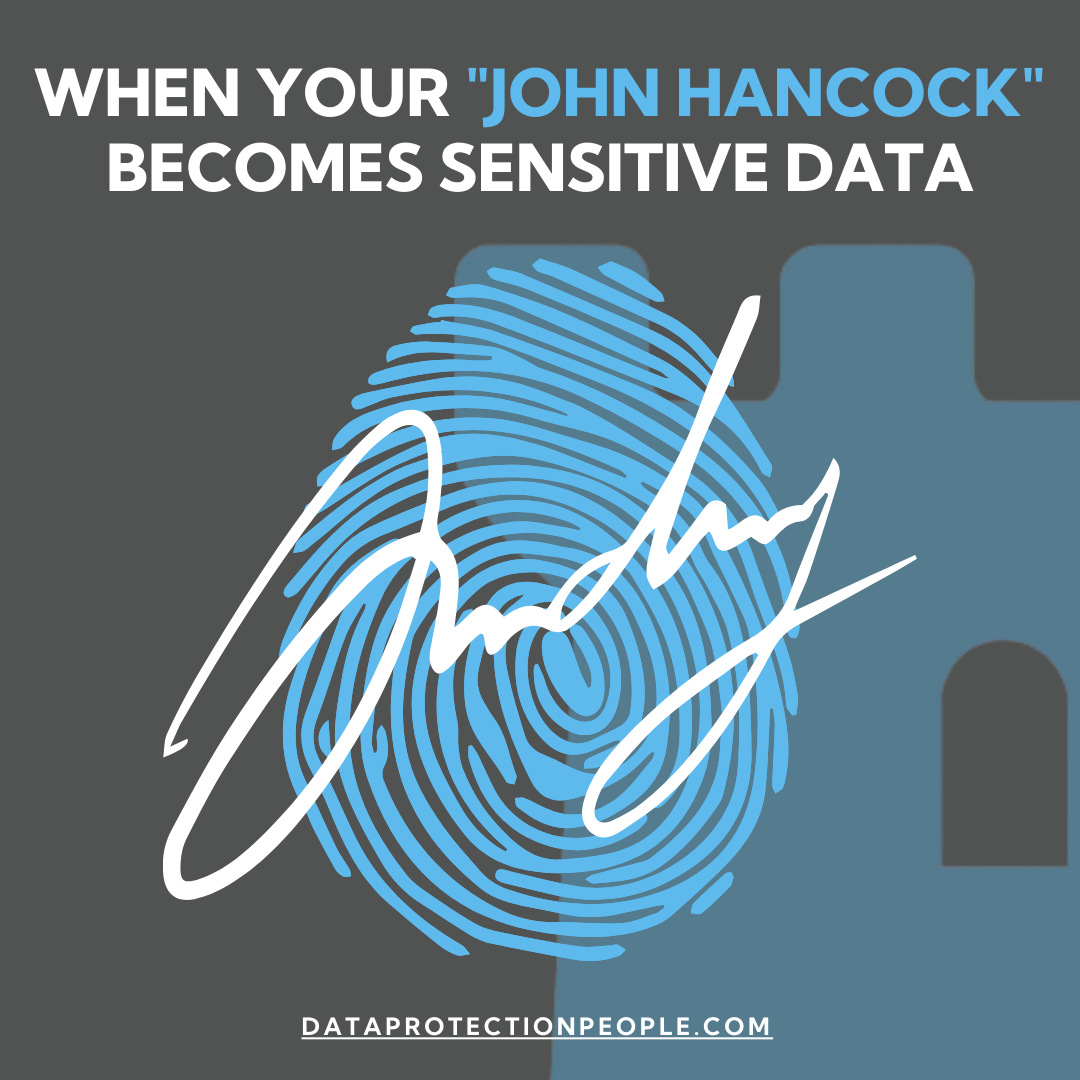
Exploring Signatures as Biometrics
When Your “John Hancock” Becomes Sensitive Data: Exploring Signatures as Biometrics
Ever looked at your signature and thought, “It’s just a fancy way I write my name”? Think again. In our increasingly digital world, that casual scribble at the bottom of forms is gaining new significance, particularly in places like Jamaica, where the Jamaican Data Protection Act (JDPA) now classifies signatures as sensitive biometric data, putting them in the same category as fingerprints and DNA.
This classification isn’t just fancy legal talk, it’s recognising that your signature has unique behavioural patterns that only you make.
What Makes Your Signature Biometric Data?
Under Jamaica’s Data Protection Act, biometric data is defined as “any information relating to the physical, physiological or behavioural characteristics of an individual, which allows for the unique identification of the individual.” But what exactly makes a signature biometric?
Consider what happens when you sign your name:
- Your hand moves in patterns nobody else can perfectly replicate
- You apply distinctive pressure with your pen
- Your personal hand-eye coordination manifests in each stroke
- Your signature even reveals subtle hints about your personality and current mood
The way you make loops in your letters, the special touches you add, and how fast you move the pen on the paper. These things are just as unique to you as your face or fingerprints.
In today’s digital landscape, e-signatures take this biometric data collection even further:
- They capture exactly how quickly you move the stylus
- They note when you pause (even for milliseconds)
- They measure precisely how much pressure you’re applying
- They record the exact timing between each stroke
The Dual Nature of Signatures
Signatures occupy a unique position in the spectrum of biometric identifiers:
- A traditional form of verification – Signatures have been used for centuries as a means of authentication, predating modern digital identification methods
- A behavioural biometric – Each signature contains distinctive characteristics including pressure points, speed, stroke order, and style that can be analysed to verify identity.
This duality creates an interesting challenge. People easily give signatures without concern, unlike fingerprints or facial scans, which raise privacy worries. However, the JDPA classifies signatures as “sensitive personal data,” meaning they need extra protection.
Take a moment to count how many times you’ve signed something in the last month alone:
- Credit card receipts
- Package delivery confirmations
- Work documents
- Medical intake forms
Each instance represents you handing over sensitive personal data without giving it a second thought!
Implications for Organisations
The classification of signatures as biometric data has several significant implications:
- Data Protection Officer Requirement: Organisations regularly collecting signatures may need to appoint a dedicated officer to oversee data protection compliance.
- Enhanced Security Measures: Signatures require stronger security measures than ordinary personal data, including appropriate technical and organisational safeguards.
- Explicit Consent Requirements: Organisations collecting signatures need proper consent mechanisms that specifically address the biometric nature of signature data.
- Records Management Challenges: Both physical and digital signatures must be properly stored, retained, and eventually disposed of with appropriate security measures.
Practical Steps Forward
Organisations processing signatures should consider taking these steps:
- Audit current signature collection practices
- Assess whether a Data Protection Officer appointment is necessary
- Review consent mechanisms to ensure they address the sensitive nature of signature data
- Implement appropriate security measures for both physical and digital signature storage
- Develop retention policies that limit unnecessary storage of signature data
Conclusion
Your signature is more than just a name. It is a piece of YOU. It is a biological data that reveals how your brain and body work together. It contains patterns as unique as a fingerprint. Yet, we share it freely without much thought. By classifying signatures as “sensitive personal data,” the JDPA highlights their role as unique personal identifiers. This recognition ensures they receive the protection they deserve.
Next time someone casually asks you to “sign here,” remember you’re not just confirming something, you’re handing over biometric data (a sensitive personal data) that’s increasingly protected by law around the world.
As businesses adjust to new regulations, they need to balance their practical needs with stronger data protection, keeping signatures both secure and easy to use.
With growing concerns about data privacy, it’s time we give our “John Hancock”, the protection they truly deserve.