
Spreadsheets to Strategy: How to Make Your RoPA Work for You
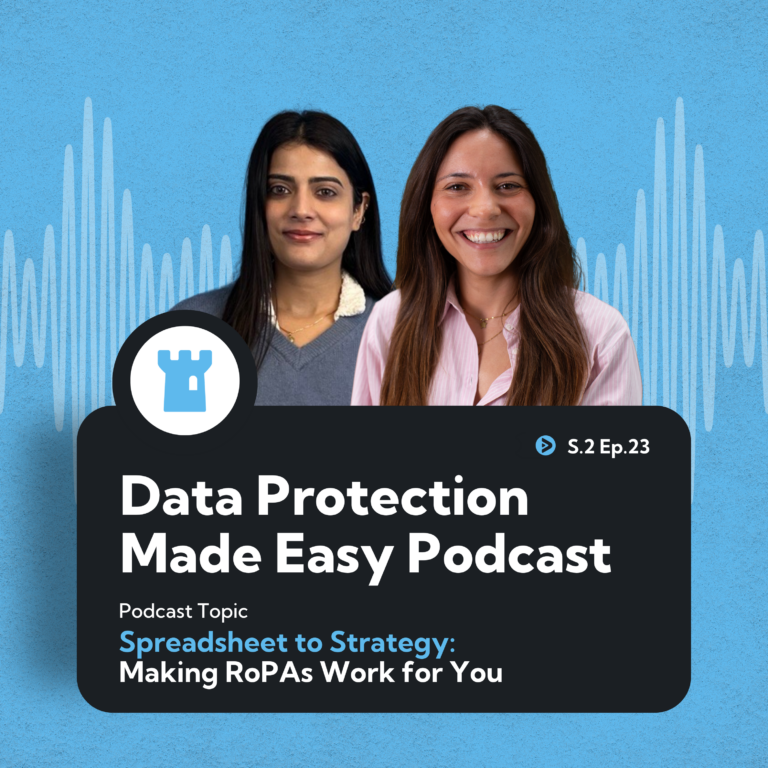
Hosted by Catarina Santos and Himanshi Gulati
Why do so many organisations struggle with their Record of Processing Activities? In this episode, Catarina Pereira dos Santos and Himanshi Gulati explore how a well-managed RoPA can become a valuable business tool, helping organisations improve governance, identify risks and strengthen data protection compliance.
Spreadsheets to Strategy: How to Make Your RoPA Work for You
For many organisations, creating a Record of Processing Activities (RoPA) feels like one of the most daunting parts of data protection compliance.
Often viewed as nothing more than a lengthy spreadsheet completed to satisfy Article 30 UK GDPR requirements, RoPAs frequently become outdated, overly complicated and rarely used once they have been created.
In a recent episode of the Data Protection Made Easy podcast, Catarina Pereira dos Santos and Himanshi Gulati discussed why organisations should rethink their approach. Rather than treating a RoPA as a compliance exercise, they explained how it can become one of the most valuable governance tools within an organisation.
From improving understanding of business processes to supporting Subject Access Requests, DPIAs and supplier reviews, a well-maintained RoPA can provide far more value than many organisations realise.
Why Do So Many Organisations Dislike Their RoPA?
One of the first topics discussed was the poor reputation that RoPAs have developed.
Catarina explained that many organisations immediately see a RoPA as a burden rather than a useful business tool.
“I work as a data protection consultant and every single time I mention RoPA to clients, they have such a bad reputation. They see it as a monster and just want to stay away from it.”
Himanshi suggested that the issue is not the RoPA itself, but the process organisations often follow to create one.
“I don’t really think that people dislike the RoPA itself. They dislike the process.”
She explained that many organisations immediately picture endless spreadsheets, large numbers of processing activities and uncertainty over who is responsible for maintaining the document.
A RoPA Should Help You Understand Your Business
Rather than approaching a RoPA as a legal requirement alone, the discussion encouraged organisations to think about what the document is actually designed to achieve.
According to Himanshi, the most effective RoPAs are built around understanding how personal data moves throughout the organisation.
“I think it’s very easy if you don’t see it as a legal requirement… you really have to understand your business and how the data is flowing.”
Understanding processing activities, data flows and ownership provides organisations with much greater visibility over their compliance position and often highlights risks that may otherwise go unnoticed.
Stop Treating It Like A Tick Box Exercise
Throughout the discussion, both hosts stressed that a RoPA should not simply exist because Article 30 requires it.
Instead, it should become part of day-to-day governance.
Himanshi explained that organisations often leave the RoPA until last, focusing on policies and procedures first.
However, she argued that the RoPA should often become the starting point because it provides the context needed for many other compliance activities.
“It’s not just filling up spreadsheets… it really gives you context.”
Why Ownership Matters
One of the biggest challenges discussed was ownership.
Many organisations assume that because a RoPA relates to data protection, maintaining it should be entirely the responsibility of the DPO or privacy team.
The hosts challenged this assumption.
Catarina explained that whilst the privacy team may oversee the document, individual departments are far better placed to understand how personal data is actually processed within their own areas.
Process owners should therefore play an active role in maintaining their sections of the RoPA, ensuring it reflects how the organisation really operates.
Without that ownership, documents quickly become inaccurate and lose much of their value.
Workshops Often Reveal More Than Expected
The conversation highlighted how collaborative workshops frequently uncover processing activities that departments had not initially considered.
Himanshi shared an example of working with a marketing team that initially believed they did not process much personal data beyond sending emails.
However, further discussion revealed they were collecting competition entries, storing winner information, sharing data internally and publishing photographs on social media.
These discoveries demonstrated why conversations with departments are often far more valuable than asking them to complete a spreadsheet in isolation.
There Is No Perfect Template
Another important theme throughout the discussion was that there is no single correct format for a RoPA.
Whilst regulators provide guidance on the information that should be included, organisations have flexibility over how they record and manage that information.
Rather than copying another organisation’s template, businesses should build a RoPA that reflects their own processing activities and remains practical to update over time.
As Himanshi explained, every organisation processes personal data differently, meaning every RoPA should be tailored to suit the business.
A Good RoPA Should Work For You
Towards the end of the discussion, the hosts explored what actually makes a good RoPA.
Rather than measuring success by the number of processing activities recorded, they suggested organisations should ask a much simpler question.
Does the RoPA help people understand how the organisation processes personal data?
Can it support everyday compliance activities such as responding to Subject Access Requests, carrying out DPIAs, reviewing suppliers and identifying risks?
If the answer is yes, the RoPA is doing exactly what it was designed to do.
As Himanshi summarised:
“If you are able to understand your processing activities, understand your risks and carry out your day-to-day activities, that’s what a good RoPA will be.”
Looking Ahead
Creating a Record of Processing Activities should never be viewed as simply completing another compliance document.
When maintained properly, a RoPA becomes a living record of how an organisation handles personal data. It supports better governance, improves accountability and helps organisations identify risks before they become problems.
Rather than seeing it as another spreadsheet, organisations should view their RoPA as a strategic tool that supports almost every aspect of their wider data protection programme.
Frequently Asked Questions
What is a Record of Processing Activities (RoPA)?
A RoPA is a document that records how an organisation collects, uses, stores and shares personal data. Article 30 UK GDPR requires many organisations to maintain one.
Why do organisations struggle with RoPAs?
Many organisations see them as large spreadsheet exercises rather than practical business tools. A lack of ownership and unclear processes often make them difficult to maintain.
Who should be responsible for maintaining a RoPA?
Whilst the DPO or privacy team may oversee the document, individual departments should take ownership of their own processing activities to ensure the information remains accurate.
Should every organisation use the same RoPA template?
No. Every organisation processes personal data differently. A RoPA should reflect how your own organisation operates rather than copying another business’s template.
How can a RoPA support wider compliance?
A well-maintained RoPA can support Subject Access Requests, DPIAs, supplier reviews, risk assessments and ongoing governance by providing a clear picture of how personal data is processed across the organisation.
Need Help Creating Or Reviewing Your RoPA?
Building and maintaining a Record of Processing Activities can be challenging, especially when organisations are managing multiple departments, changing processes and increasing compliance requirements.
Our Data Protection Support Service and Outsourced DPO Service help organisations create practical, accurate RoPAs that support day-to-day compliance, not just regulatory requirements.
Whether you’re creating your first RoPA or reviewing an existing one, our consultants can help you build a record that works for your organisation, not against it.